




Pathways of Peace
Weekly Torah Commentary
Sh'lach - "Send Out"
Numbers 13:1 - 15:41
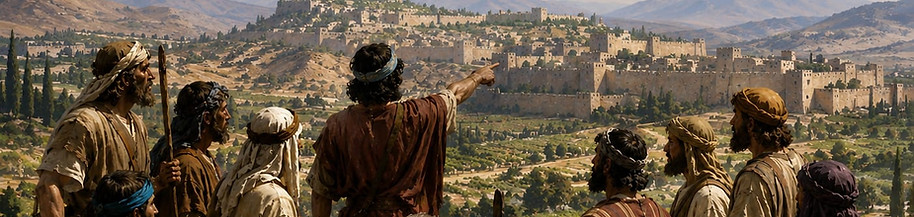
"A Seeing Faith: A Matter of Inheritance vs. Endless Wandering"
This week's Torah portion is titled Sh'lach, meaning, "Send out." It refers to the command to send out spies to investigate the Land of Promise. Joshua and Caleb stand in stark contrast to the other ten spies because they saw the same facts but interpreted them through the promises of God. All twelve men witnessed the fortified cities, the powerful inhabitants, and the challenges that lay ahead. Yet only Joshua and Caleb viewed the land through the lens of covenant faith. Their faith was not blind optimism; it was a faith informed by what they had already seen God do.
The Torah repeatedly emphasizes the concept of seeing:
● Israel had *seen* the plagues in Egypt,
● they had seen the Red Sea parted, *seen* the pillar of cloud and fire, and
● they had seen the provision of manna.
● they had seen the Sh'chinah (manifest Presence) power atop Mt. Sinai.
Biblical faith is not a leap into the dark but a response to the revelation of God. Joshua and Caleb looked at the obstacles in Canaan and remembered the mighty acts of ADONAI. The ten spies looked at the same obstacles and forgot what they had already witnessed.
In Numbers 13–14, the majority report was essentially a crisis of vision--a disbelief in God's ability to make good on His promises. This quickly metastasized to the general population, and would eventually lead to the destruction of an entire generation.
The ten spies saw giants and concluded, "We are like grasshoppers." Joshua and Caleb saw the same giants but concluded, "Their protection has departed from them, and ADONAI is with us" (Num. 14:9). The issue was not eyesight but rather the spiritual insight that Joshua and Caleb walked in. One group interpreted reality through fear; the other interpreted reality through faith--internalizing what they saw as not a one-time demonstration of a holy God, but believing that his miracles will continue forever.
This is a powerful lesson about trusting God's promises concerning Messiah and the Kingdom. Faith does not deny reality; it places reality under the authority of God's eternal and enduring Word. Joshua and Caleb possessed what I call a "seeing faith"—a faith that sees beyond present circumstances to the faithfulness of God. Their confidence was rooted in the established covenant, not in their own strength or perceived inabilities.
The consequences of unbelief were devastating. The generation that left Egypt was redeemed from slavery but did not inherit the Land. They experienced deliverance but forfeited inheritance--forced to wander in circles until death. It would have been better had they not experienced the deliverance to begin with. At least then, the Name of God would not have been profaned.
The wilderness became a graveyard of unrealized promise. Their unbelief did not merely rob them of blessings; it excluded them from entering the very destiny God had prepared for them.
This serves as a sobering warning. Salvation from Egypt was not intended to be the end of the journey, but the beginning. God's purpose was always entrance into the Promised Land. Likewise, believers today are called not merely to be redeemed, but to walk faithfully into the fullness of God's purposes.
Unbelief can cause God's people to wander in circles when He intends them to move forward in covenant inheritance.
Joshua and Caleb, however, received the reward of faith. They entered the Land because they "followed Adonai fully" (Num. 14:24). Their lives testify that faith is not wishful thinking but a steadfast confidence in the God Who keeps His promises. They saw the giants, but they also saw something greater—the Presence and power of the Holy One of Israel.
The lesson remains: we all face giants, but the decisive question is not what we see. The decisive question is whether we see our circumstances through the greatness of God or see God through the perceived "greatness" of our circumstances. Joshua and Caleb inherited the Land because they remembered what God had already revealed and acted accordingly. Their "seeing faith" led to inheritance; the unbelief of the ten spies led to tragic loss.
בְּהַעֲלֹתְךָ/B'ha'alotcha "When You Set Up."
Numbers 8:1 - 12:16
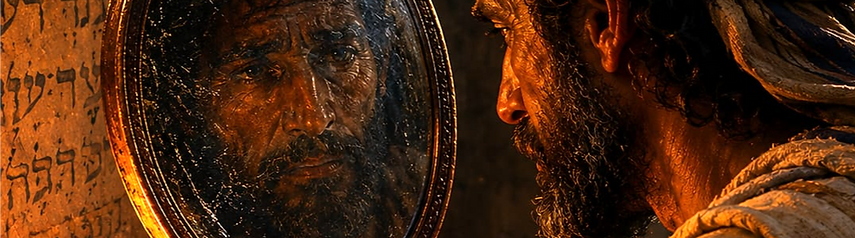
Torah, Mirror, and Heavenly Vision
This week's Torah portion is בְּהַעֲלֹתְךָ/B'ha'alotcha, which means, "when you set up." It's found in Num. 8:1-12:16. The title refers directly to the setting up of the seven-branch menorah, also known as the "eternal light." It goes without saying that light is required to see, and on a spiritual level, this is an extremely important principle. In this Torah reading, we would be remiss to not discuss the "vision" that God gives to the prophet (Num. 12:6), mentioned at the very end of the reading.
The Hebrew root רָאָה/ra'ah (to see) gives rise to מַרְאָה/mar'ah, a word that can mean both a "vision" and a "mirror." This linguistic connection is profound because Scripture consistently links true seeing with divine revelation.
In Exodus 38:8, the laver of the Tent of Meeting was made from the bronze mirrors (mar'ot) of the women who served at the entrance of God's House. These were not glass mirrors that modern society enjoys, but highly polished bronze surfaces capable of reflecting an image--offering a more distorted perspective. Symbolically, the mirrors that once reflected the outward person were transformed into the vessel of cleansing before entering God's very Presence.
Here the Torah presents an important lesson: before approaching the Holy One, one's reflection must pass through the waters of purification. The mirror becomes more than a tool for seeing oneself—it becomes a means of spiritual preparation.
Ya'acov (James) appears to draw upon this imagery:
> "For if anyone is a hearer of the word and not a doer, he is like a man looking at his natural face in a mirror. for once he has looked at himself and gone away, he has immediately forgotten what kind of person he was." 1:23-24)
For Ya'acov, the Word of God functions as a mirror. Torah reveals not merely our appearance but our true condition before God. The problem is not as much that the mirror is unclear; but rather that the observer walks away unchanged. Genuine vision demands response. It's transformative.
From a Hebraic/biblical view, the connection deepens. The polished bronze mirror of ancient Israel reflected light. The brighter the light, the clearer the image. Likewise, Torah reflects the holiness of God, exposing both His character and our need for transformation. Yet the fullest revelation comes through Messiah Yeshua, who embodies the Torah and reveals the Father perfectly. In seeing Him, one has effectively seen the Father.
The dual meaning of mar'ah—mirror and vision—suggests that biblical revelation is itself a kind of mirror. When we gaze into God's Word, we are not merely looking at commandments; we are being invited into a heavenly perspective. We begin to see ourselves as God sees us and to see God's purposes more clearly.
This may also shed light on Rabbi Paul's words:
> "For now we see through a mirror dimly, but then face to face" (1 Corinthians 13:12).
Ancient bronze mirrors, though polished, could never provide the perfect clarity of direct sight. Even the greatest prophetic visions remain partial reflections of heavenly realities. Yet every glimpse prepares us for the day when faith becomes sight.
The Tabernacle laver made from מַרְאֹת/mar'ot therefore becomes a beautiful picture of discipleship. The worshiper looks into the mirror of Torah, is cleansed by God's provision, and is prepared to enter His holy Presence. The mirror becomes a vision, and the vision leads to transformation.
For us, this ancient journey culminates in Yeshua. As we behold Him—the living Torah and perfect image of the Father—the bronze reflection gives way to the reality toward which it always pointed. What began as a mar'ah (mirror) becomes a mar'eh (heavenly vision), until one day we shall see Him face to face.
Nasso - "Take"
Numbers 4:21-7:89

This week's Torah portion is titled "Nasso", meaning "take". It spans Numbers 4:21-7:89. The text continues the census process that began in the first section of Numbers, and covers a great deal of subjects. The focus seems to continually circle back to cleanness and purity before God--speaking directly to both the challenges of our fallen condition, and the expectations required by a holy God.
One particular section discusses repentance and restitution when a person has sinned against another.
Confession would be an integral part of this process. Why would confession so regularly take place before man? Because so many of our offenses towards God resulted from our treatment of others. As such, there is an deep connection between our treatment of others, and the way in which we are treated by God. The reason that the flood fell upon the earth was due to the way in which people treated each other. The Scriptures state that the earth was filled with violence. This "chamas" was the root of "chametz", which is the leavening symbolizing sin. It is taught that the source of Israel's dispersions, as well as the Temple destructions resulted from the awful ways with which people treated and spoke about each other.
Several weeks ago we saw that the Tzara'at affliction which relegated the offender to the outside of the camp resulted from evil speech committed against others. So we shouldn't be surprised when we read the words of Ya'acov (James), Yeshua's brother, say in 5:16, "confess your sins one to another." This week's reading contains within it an important text on the connection between grievances towards man and their effect on God. Num 5:6-7 states:
"Speak to the sons of Israel, 'When a man or woman commits any of the sins of mankind, acting unfaithfully against ADONAI, and that person is guilty, then he shall confess his sins which he has committed, and he shall make restitution in full for his wrong and add to it one-fifth of it, and give it to him whom he has wronged"
Here, you see that the way in which we treat one another is near and dear to the heart of God. The text states that a person sinning against another is not only being unfaithful to God. The word "ma'al" translated as "unfaithfully" actually means "treachery." Treachery towards man equates to treachery towards God. As the verse above states, one had to go above and beyond in order to rectify the situation.
A common mistake made by some attempting to walk out confession is to not take into consideration how the opposite party will be emotionally affected. One author writes the following:
"A husband should probably not say to his wife, 'I apologize for gazing at women whom I find more attractive than you.' Sometimes the desire to confess a sin to a person who does not know about the sin stems from a selfish desire to relieve one's own feelings of guilt." This is something to consider.
As we continue on this faith journey, let us be mindful of our neighbor, and the love God has desired that we show one another. Our treatment of others is watched closely by God